shepherd
Get it

AI culling
that never
leaves your
desk.

  • No cloud, no account
  • No upload, no connectivity issues
  • No subscription, no tokens
  • Windows · macOS · Linux

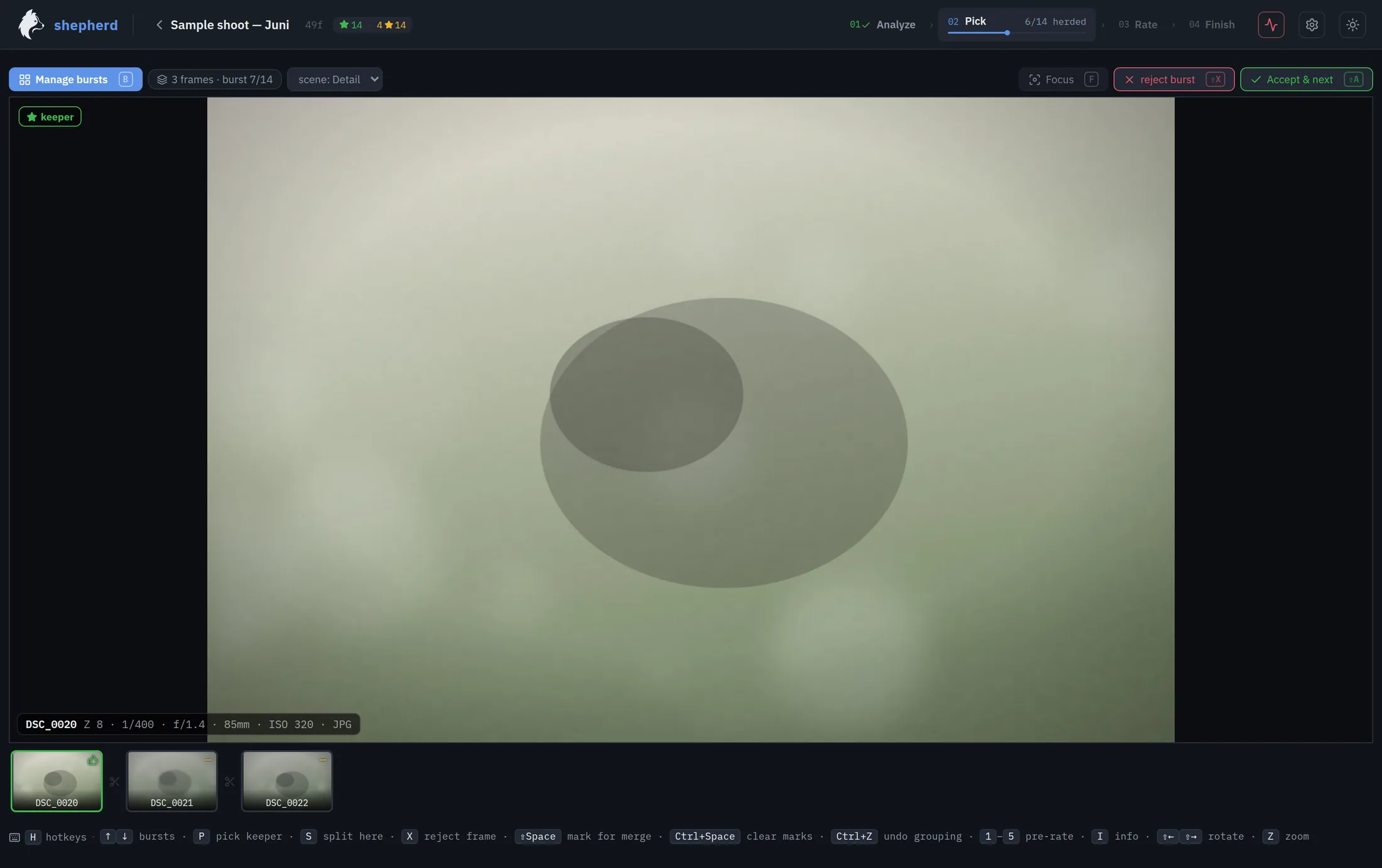
shepherd checks what you'd check first: Focus. Open eyes. The expression. The peak of the movement. shepherd groups similar pictures and recommends a pick. Yet you have the control.

The Pick step: one burst on the stage with its proposed keeper, the burst list beside it and the frames of the currently selected burst on a strip below.

How it works

Point it at a folder.
Grab a coffee.

01Load

Drop your shoot in

Point shepherd at the flock of frames in your folder. shepherd works in place and copies nothing.

02Cull

shepherd groups & selects

Bursts collapse, the misses fall away and one is selected.

03Rate

The final human touch

shepherd proposes, you decide. Cut, keep, rate as favourite.

04Ship

Hand off clean for editing

Stars and labels write as metadata (XMP or the image file). This serves as the handover to your usual editor.

Step 01 · Load

Drop your shoot in

Point shepherd at the flock of frames in your folder.

RAW or JPEG, or both, shepherd works them where they sit.

No upload, no connectivity issues, all local on your device.

shepherd rounds up the whole shoot

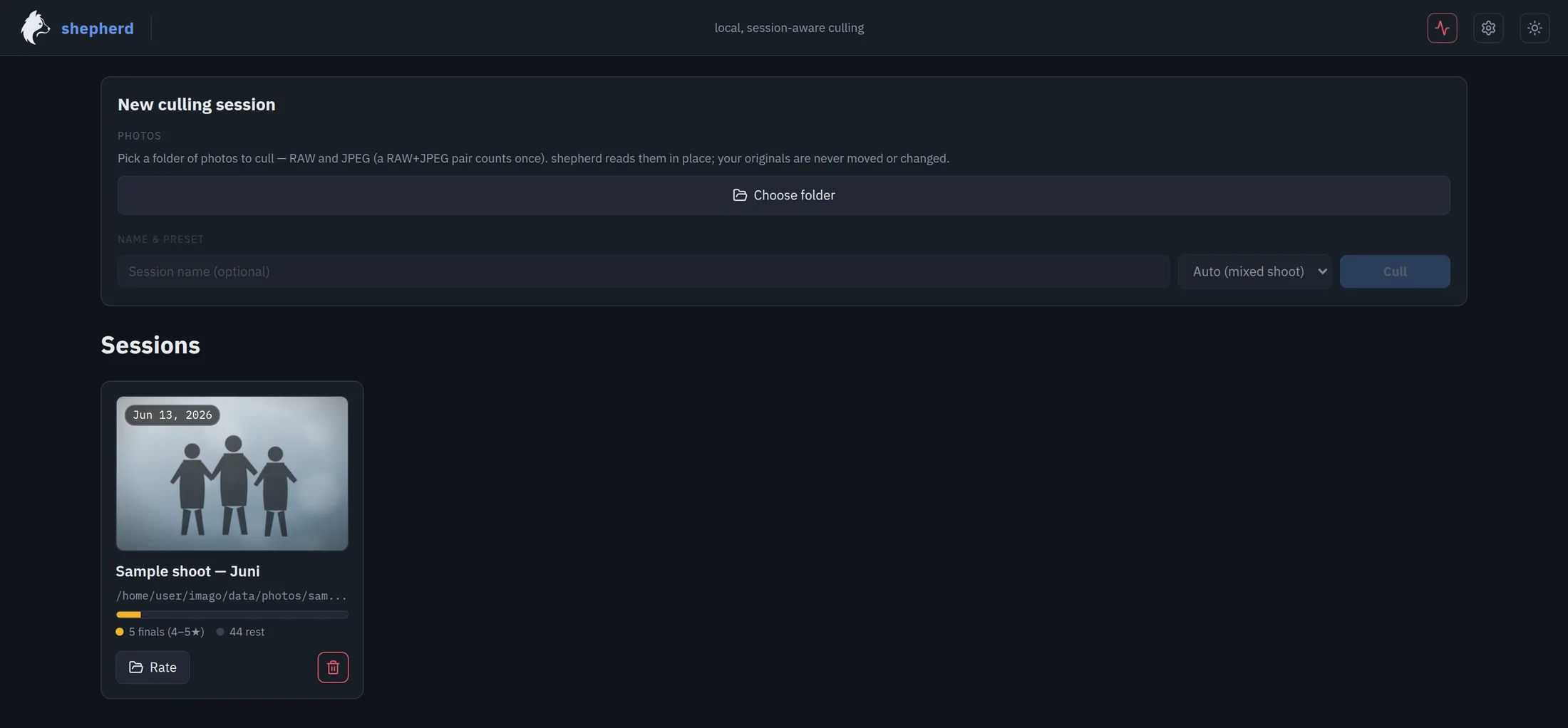
Starting a session in shepherd: a folder picker, a name and a scoring preset, with an earlier shoot listed below.

Step 02 · Cull

shepherd groups & selects

All frames are scored for similarity: color, contrast, time distance. shepherd splits the flock of frames into bursts.

Every frame gets a score with an eye on sharpness, smiles and the peak of the movement. Closed eyes and blurred misses are scored lower.

shepherd sorts the frames in a burst. The best frame of each burst is proposed as a keeper.

You decide at any time whether the bursts stay as they are and which frame is selected as a keeper.

driven into groups and ready for rating

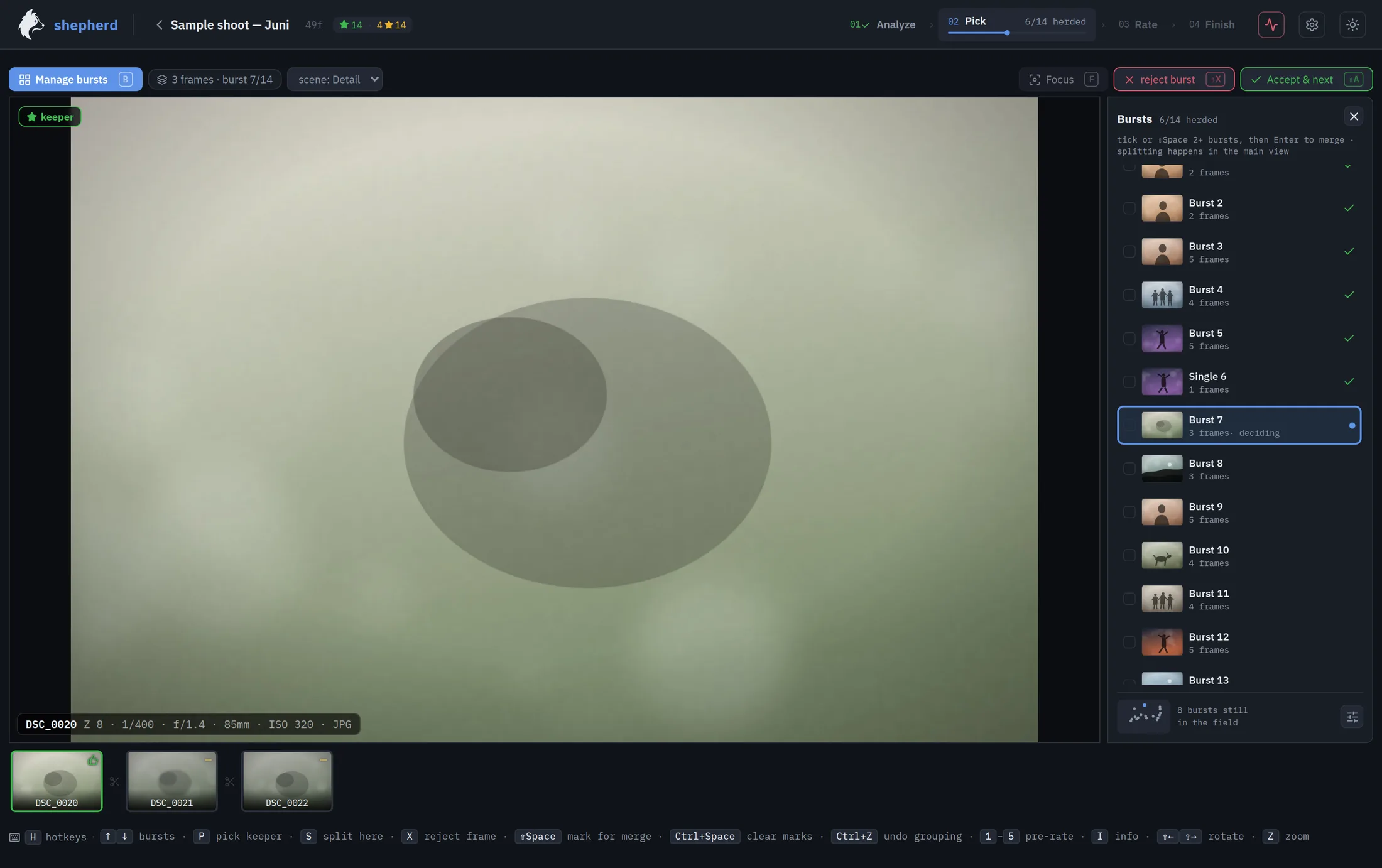
The Pick step with the burst list open: fourteen bursts, six already "herded" (one frame selected), and the current burst's frames on a filmstrip below.

Step 03 · Rate you decide

The final human touch

shepherd proposes. You have the last word. Disagree any time.

One hand on the keyboard using quick shortcuts: keep, cut, or set the stars for your favourites.

You form the herd and your final selection to your taste.

one frame picked out of the flock

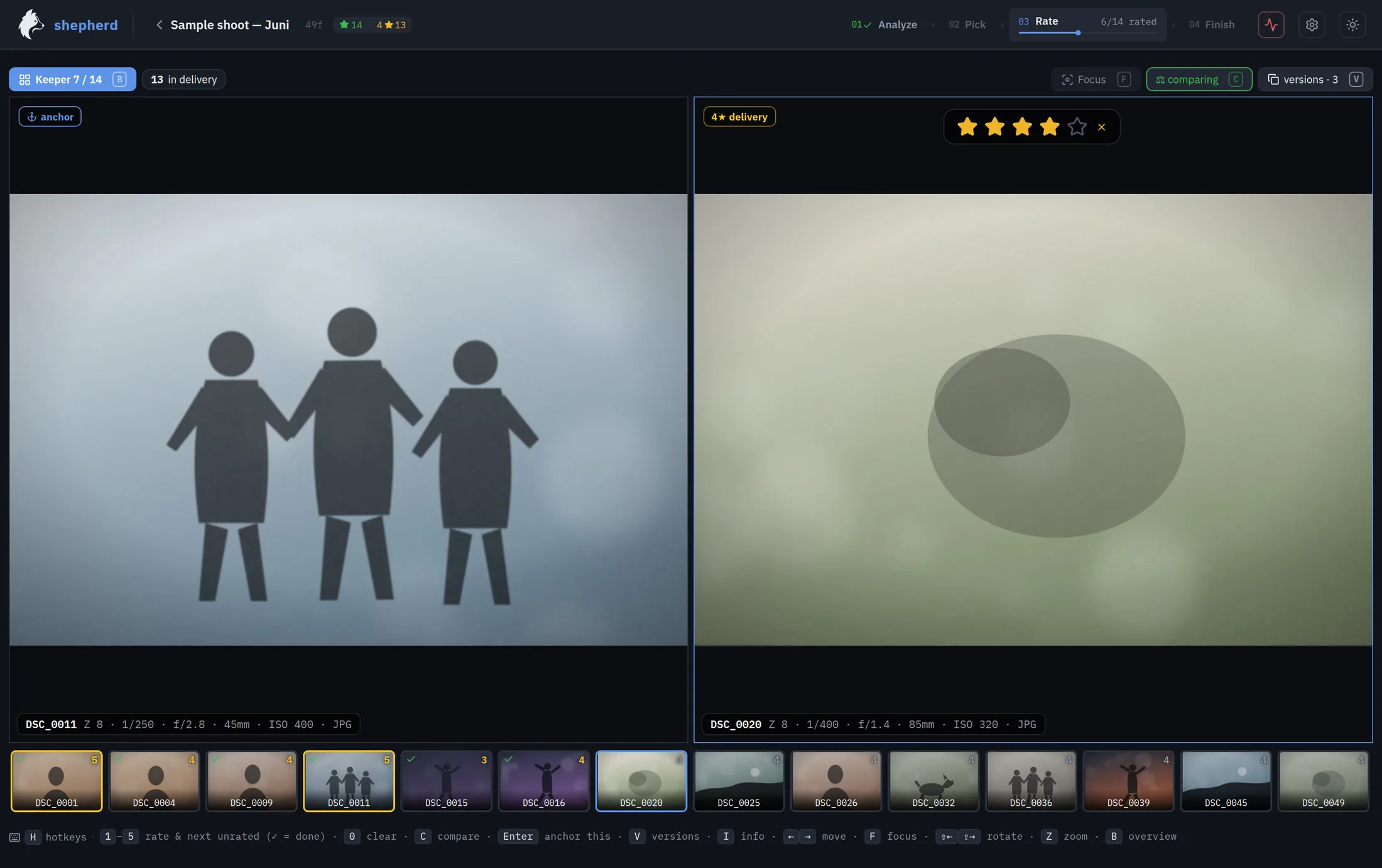
Two keepers side by side in the compare view, the right one rated four stars for final delivery, with the full keeper filmstrip along the bottom.

Step 04 · Ship

Hand off clean

shepherd writes star ratings and markers straight to XMP sidecar files. The original frames stay untouched.

Open your favorite editor like Lightroom, Capture One, or your camera manufacturer's software and your picks are already there.

As an option, shepherd is able to write the metadata directly into the original files, as some editors do not support XMP. The pixels remain untouched, only the metadata is written. On request, shepherd creates a backup for you.

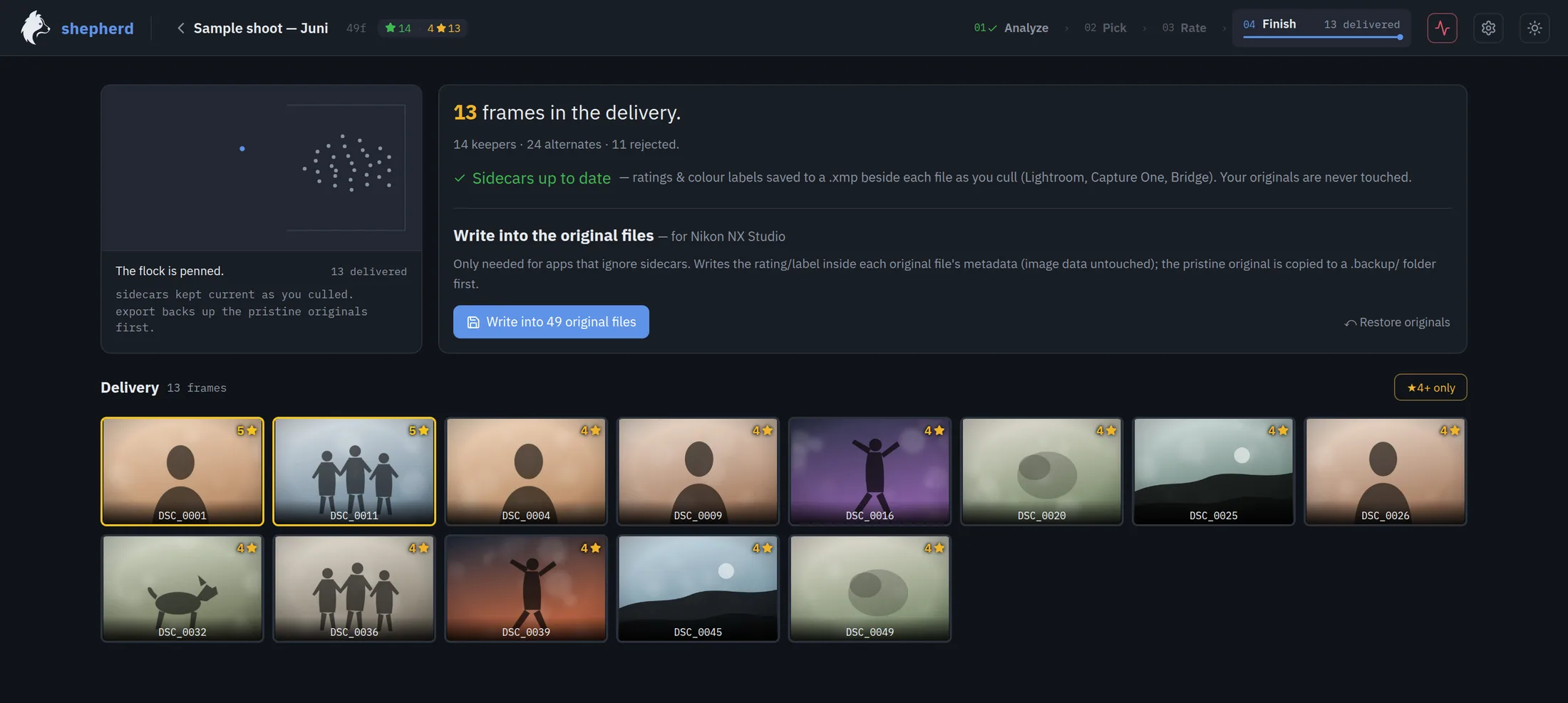
The whole flock of frames is split, sorted, penned and delivered.

XMP written · 13 keepers

5★ × 2 · 4★ × 11

penned into the delivery folder

The Finish step: thirteen frames in the delivery, a note that XMP sidecar files are up to date, and the option to write ratings into the original files.

Why shepherd

Why I built it
this way.

Four reasons why shepherd can be the perfect addition to your workflow.

01 · The verdict

The AI suggests, you decide

Every pick is a suggestion, and you can see what it was based on: sharpness where it matters, whether the eyes are open, the expression, where the movement peaks.

Disagree and one key fixes it. shepherd counts the score and compares.

Which frame is actually good is still your call. It never writes down a decision you haven't confirmed.

02 · The storage location

Your clients never leave your system

Everything runs on your computer. Your photos, their filenames and your folder structure stay there. No upload, no account.

Weddings, boudoir, babies and children, hospital work, anything under an NDA: the files stay where you put them. Go offline and carry on culling.

That is also why there is no waiting at the start: no upload, no connectivity issues.

03 · The bill

You pay once

One price, one payment. No monthly fee, no credits or tokens, no charge per image.

Nothing ticking away while you go back and forth between two frames for the third time.

Two hundred photos or twenty thousand, it costs the same.

04 · The fit

Travel pictures or multi-camera weddings

Same program either way. Start with the smallest package.

Take the shooting statistics when you get curious about your own habits. Or if you want to be sure which lens to add to your kit.

Take the local learning once culling is a weekly job rather than an occasional one, and you want to tune the AI to your own taste.

Shooting statistics · Packages: Flock and Range

See how you
actually shot it.

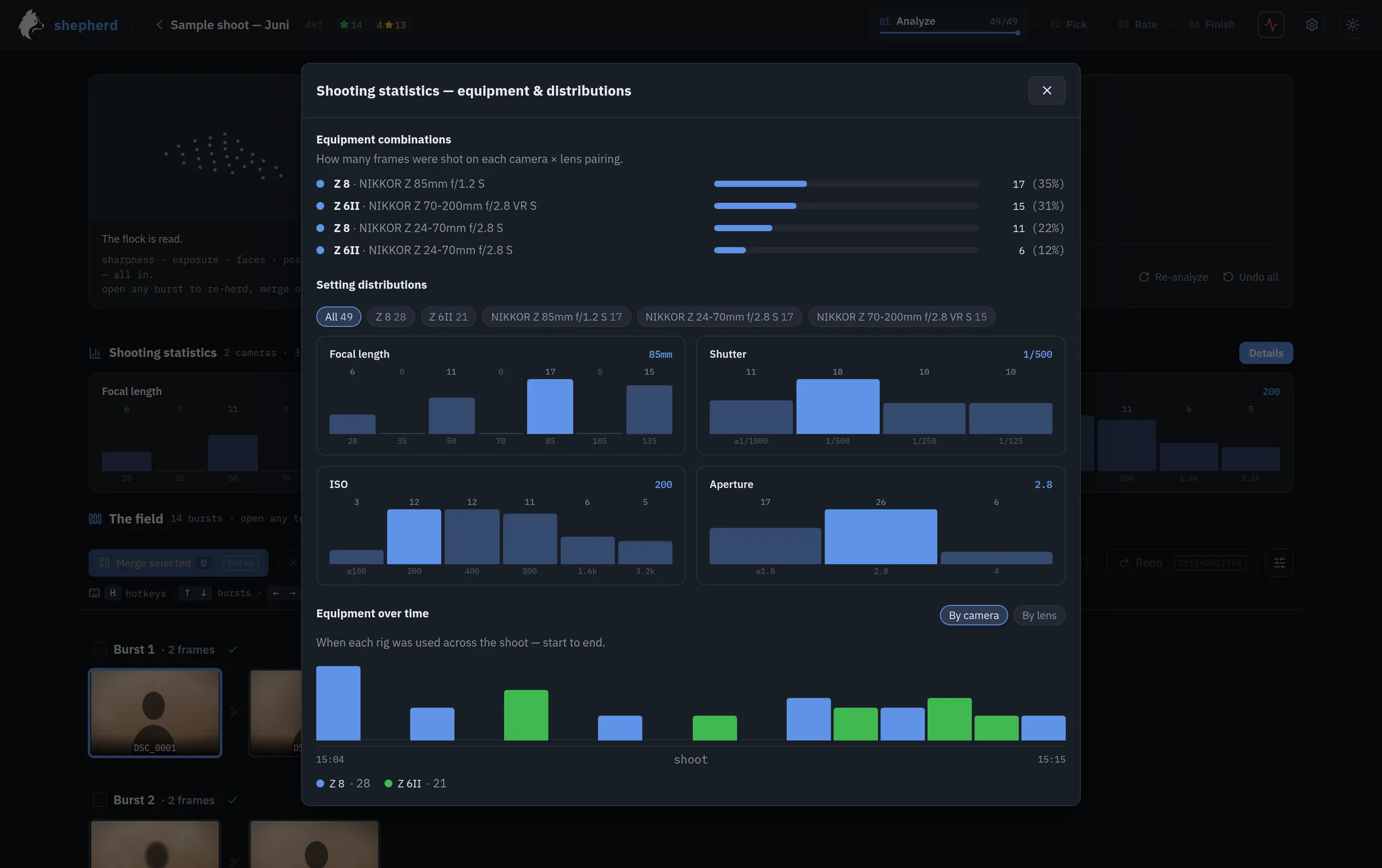
Every frame remembers what the camera was set to. Read together, a shoot tells you things worth knowing: the focal length you never move off, the lens that stayed in the bag all day, the body that quietly did most of the work.

The statistics dialog: camera and lens combinations with their share of the shoot, distributions for focal length, shutter, ISO and aperture, and a timeline of which body was in use when.

Distributions

Focal length, shutter, ISO and aperture across the whole take, or narrowed down to one body or one lens.

Equipment

Which camera and lens combinations did what share of the work, so a one-sided day with two camera bodies shows itself.

Timeline

What equipment was in your hand when, from the first frame to the last.

License options

Pay once.
Own it forever.

Same program, same analysis in every package. No performance limit, no watermark, no photo limit.

Field

120

one payment · for all occasions


  • Groups bursts & near-duplicates
  • Auto selection & quick keyboard overrides
  • 1v1 split compare & focus area
  • Writes stars as XMP sidecars
  • No limit on photos or shoots
  • Licensed for 1 computer
Ask about Field

Range

180

one payment · and shepherd learns


  • Everything in Flock
  • Learns from your picks & corrections
  • Training runs on your machine, never uploaded
  • Optional, switch it off any time
In development

One year of updates included · major new releases excluded · pay once, in euro

Contact

Whistle and
I'll come.

Questions about a package, an odd camera, a studio licence, or whether shepherd fits the way you work? Write to me. I read and answer everything myself.

hello@shepherd.photo

I answer in English and German. I use your address to answer you. Not to put you on a list.

Rather just send an email? hello@shepherd.photo works the same.

FAQ

Some frequent questions.
Short answers.

Do my photos leave my computer?

No. Your photos, their filenames and your folder structure stay on your disk. shepherd analyses, scores and writes on the machine it's installed on, with no upload and no account, and it culls happily with the network access switched off.

The one thing that talks to a server is the licence: activating your key, and re-confirming it now and then, sends the key and an anonymous device fingerprint. No pictures leave your machine.

Will shepherd touch my original files?

Not without a backup. By default your decisions go into XMP sidecar files next to the photos and the originals stay untouched, byte for byte.

If you ask shepherd to write the rating into the file itself, which some editors need because they ignore sidecar files, it copies the untouched original into a backup folder first as a default option. You can put every one of them back.

Does shepherd work with Lightroom and Capture One?

Yes. Sidecar files and metadata are how these programs already talk to each other: Lightroom, Capture One, Photo Mechanic, Bridge and FastRawViewer all read the stars and colour labels.

shepherd sits before your favourite editor and has no ambition to replace it.

Which cameras and file types does shepherd support?

The usual RAW formats from the usual manufacturers, plus JPEG, PNG, TIFF and WebP. By the way, a RAW+JPEG pair of the same shot counts as one photo.

Some metadata that is important for the analysis is missing in some RAW formats. Then shepherd cannot evaluate it. This affects e.g. the focus indicator.

If you shoot something unusual, send me the camera model and I'll tell you straight whether it works.

What hardware do I need?

A normal current laptop or desktop PC. Everything runs on the CPU, so there's no graphics card to buy and nothing falls back to the cloud. More cores means the flock of frames comes in faster as shepherd uses everything which is available by default.

Starting with the package Flock, shepherd can be told to use only some of the resources of your computer so that you can continue working in other programs at the same time.

In the package Range, shepherd learns from your decisions and corrections. The training runs on your computer and does not require any special hardware.

Really no subscription?

Really. One payment for the package you pick. No monthly fee, no charge per image, no API credits or tokens.

The analysis runs on hardware you already paid for.

How do I get my licence key?

By email, as soon as the payment clears. It looks like SHEPHERD-XXXXX-XXXXX-XXXXX. Paste it into shepherd once, under Activate.

The licence doesn't expire and shepherd keeps culling offline. shepherd reaches out to the licence server now and then only to re-confirm the license is still valid.

How many computers can I use shepherd on?

Field covers one. Flock and Range cover two on one key. Ideal for your desktop and a laptop.

If you replace a machine, release its slot from inside the app and activate the new one.

What if I disagree with its picks?

Then you overrule them. That's just one keystroke, and the shoot is yours again. shepherd never writes down a decision you didn't confirm.

On Range those corrections are exactly what it trains on, on your machine, so it moves towards your eye rather than an average one.

Can I move between packages later?

Yes. They're the same program, so moving up a package means paying the difference and nothing else. Write to me and I'll sort it out.